
When Danielle Sansano, Peer Support Worker at The Neighbourhood Group (TNG), first heard about the Next Chapter, a new rapid-discharge program for people recently hospitalized with substance-use challenges, she immediately felt drawn to the work.
“I was at another hospital at the time and too busy to apply. I was devastated,” Danielle recalls. “But I told my manager to please keep me in mind if the role re-opened.” A week later, her supervisor called about a vacancy. “I jumped at the opportunity. I was excited and, honestly, so grateful. My heart felt full knowing I could use my experiences to support others.”
For Danielle, that pull toward the work reflects a broader need she sees every day. The initiative—developed through ongoing collaboration between the Centre for Addiction and Mental Health (CAMH) and TNG—provides seamless support during the vulnerable transition from hospital to home. “We’re seeing a big need for more accessible and rapidly available substance use programs in the city, especially for people transitioning out of the hospital,” says Danielle.
When people are discharged from the hospital after treatment, they’re often placed on waitlists for continued care—and it can be months before a service opens. Those long stretches between care are some of the most challenging moments for people living with substance use disorders. Many are also coping with housing instability, financial insecurity, and complex mental health needs. And, after medical withdrawal, their tolerance to substances has decreased significantly, making return to use dangerous and potentially fatal.
“Leaving the hospital often means returning to the same environment: sometimes a shelter, sometimes an unstable relationship,” says Danielle. “Because continued care isn’t always immediately available, it can be easy to slip into old patterns. It’s a vulnerable time, and support from someone with lived experience can help clients face their fears and sort through their feelings and options.”
That’s where the Next Chapter comes in. The program builds on the Intensive Recovery Discharge Team model created by Dr. Narges Beyraghi and Dr. Pamela Kaduri. The Next Chapter supports people transitioning out of inpatient programs—such as CAMH’s Medical Withdrawal Service, a two-to-three-week withdrawal and stabilization program—and offers mental health services, medication management, psychoeducation, peer support, and referrals to ongoing therapeutic care and other community resources, along with support for family members and caregivers.
Recognizing the importance of support after discharge and the need for connection, the program matches each patient with a Peer Support Worker for four weeks following their hospital stay. Patients also work closely with a physician, a social worker, and a pharmacist, making the Next Chapter a truly multidisciplinary, wraparound service.
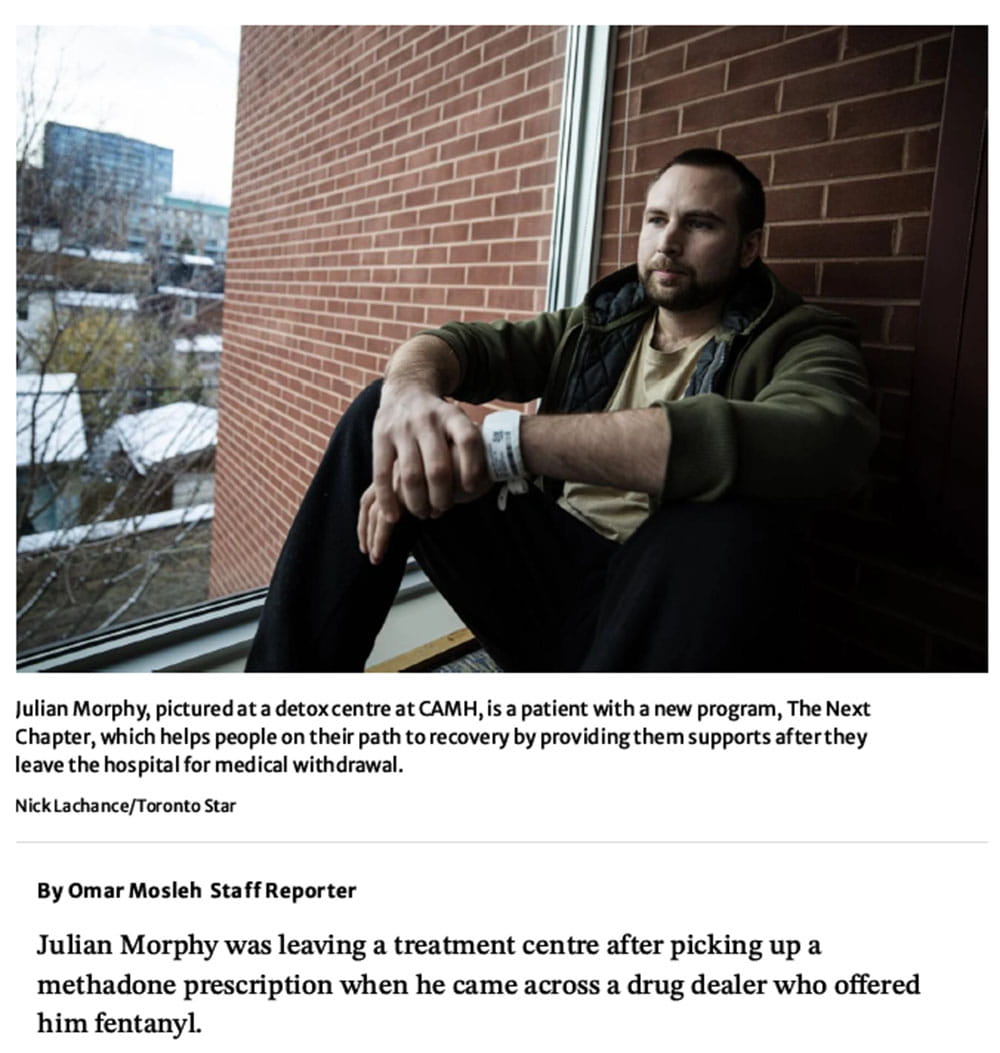
The Next Chapter was recently featured in a Toronto Star article, highlighting the story of Julian Morphy, who has been a client of The Next Chapter—read the full story here.
Peer support staff bring lived experience with mental health and substance use challenges and offer understanding, partnership, and daily assistance to support clients as they reintegrate into the community. “As peers, we support clients with their most urgent needs that arise at this delicate time and help them stay on track with their care plan,” says Danielle. “That includes navigating application forms, phone calls, appointment reminders, clothing/food banks, support meetings, legal issues, Ontario Works/Ontario Disability supports. For an individual trying to manage all of this on their own, immediately after discharge, without support, this can be impossible.”
“I have approximately 25 years of lived experience with substance use,” explains Danielle. “I can tell you what it is like to go to a withdrawal center, or what it is like being on suboxone or methadone. I know the sting of shame when police put handcuffs on you. Being a peer is like having one foot in an old life, and the other planted firmly in hope. It means turning my experience into strength and walking beside others as they discover their own. I don’t see peer work as a job; this is my calling.”
Many clients describe The Next Chapter as the first time they’ve felt consistently supported after leaving the hospital. “It’s powerful to see clients engage with the program and really put in the effort to maintain their recovery,” says Danielle. “One client told me she felt lucky to enter the medical withdrawal unit at CAMH and, later, the Next Chapter. She took every suggestion, attended her appointments, secured housing, and showed up for her support meetings. She shared that the intensive support was what finally made recovery feel accessible.”
As we reflect on the last year, the Next Chapter has been an incredibly successful initiative. With 39 clients having gone through the program so far, over 90% remained with the program for the full four weeks—an impressive rate given the challenges faced by people in these circumstances.
“This model works because we’ve created it through genuine partnership,” says Michael Waglay, Manager of Community Peer Programs at The Neighbourhood Group (TNG). “CAMH clinicians bring expertise in acute withdrawal management, and TNG has decades of experience in community-based peer support for people with substance use challenges. With both strengths in mind, we’ve designed a program that bridges the gap between hospital discharge and long-term treatment.”
This work is possible thanks to almost $2 million in funding from Health Canada’s Substance Use and Addiction Program (SUAP), which has allowed the teams to build an innovative, evidence-informed model that is already changing lives. CAMH and TNG have received funding from SUAP before, most notably TNG’s successful Crystal Meth Project. This unique program connects users with safe and welcoming drop-in services, peer training and support, referrals to health service providers, and community-building activities, challenging stigma and fostering compassion for users.
Looking ahead, CAMH and TNG hope to grow the Next Chapter by adding more Peer Support Workers, ensuring that more clients can access this essential support. There is also early excitement about expanding this model into other settings, including the CAMH Emergency Department.
“Our goal is to turn the Next Chapter into a best-practice model,” says Dr. Lena Quilty. “Into a program that other healthcare organizations can easily replicate to improve outcomes for people with substance use challenges everywhere.”
About the Centre for Addiction and Mental Health (CAMH)
The Centre for Addiction and Mental Health (CAMH) is Canada's largest mental health and addiction teaching hospital and a world leading research centre in this field. CAMH combines clinical care, research, education, policy development and health promotion to help transform the lives of people affected by mental illness and addiction. CAMH is fully affiliated with the University of Toronto and is a Pan American Health Organization/World Health Organization Collaborating Centre. For more information, please visit camh.ca or follow @CAMHnews on Bluesky and LinkedIn.
About The Neighbourhood Group
The Neighbourhood Group Community Services (TNGCS) supports more than 47,000 low-income individuals and families across 35+ Toronto locations. Its mission is to work with people at every stage of life, delivering effective programs and advocating for a more equitable, just, and vibrant community. With over 1,000 staff and 800 volunteers, TNGCS tackles Toronto’s most urgent issues, including poverty, homelessness, mental health, unemployment, social isolation, substance use, conflict, violence, youth alienation, and newcomer settlement. For more information, visit tngcommunityto.org or follow @tngcommunityto on Instagram, LinkedIn, Facebook, and X.


